
Published 5 min read
Why We Show Circles on the Map, Not Pins
Learn how StuffRescue protects your location and ensures privacy when giving away items by using neighborhood map circles instead of exact pins.
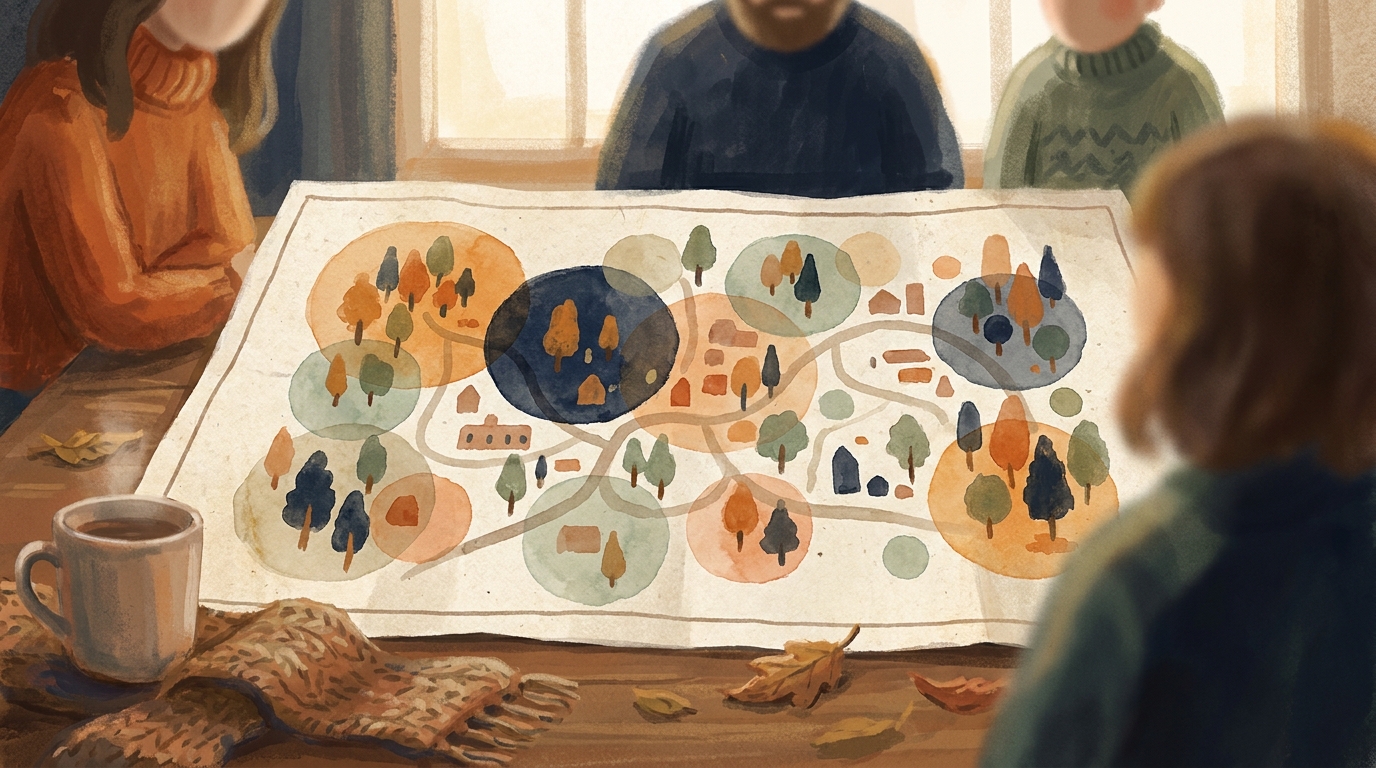
When you offer a lamp or a dresser to your neighbors, you want it to find a good home, but you also want to protect your location. We built StuffRescue to ensure privacy when giving away items. Here is a look behind the scenes at why our map uses neighborhood circles instead of pins to keep your home address secure.
The problem with map pins and privacy when giving away items
When StuffRescue first started in Akron, Ohio, we used a different design for our map. An early version put a pin near each item and a dot on the member's own home. At first glance, this seemed like a helpful way for neighbors to see exactly how close an item was before they decided to rescue it.
However, as we tested the app on detailed street maps, we noticed a major issue: those pins read as "that house." Even if the pin was slightly offset, it was too close for comfort.
Precise geolocation data is considered highly sensitive personal information because it reveals intimate details about where individuals live, work, and spend their time. Consumer advocacy groups have increasingly targeted the unauthorized sharing of this data. In fact, organizations like Consumer Reports have released model legislative frameworks designed to help states ban the commercial sale of consumers' precise geolocation data.
We realized that showing exact points on a public map conflicted with our goal of creating a comfortable, secure environment for everyone.
How map privacy works on StuffRescue
We knew we had to rebuild the map. Today, when you browse free things near you, you will never see addresses or exact points. Instead, the map shows neighborhood circles with counts of the items available in that area.
A member sets their home location once, on the map. We use this saved location to calculate the distance to an item. Rescuing anything within 3 miles of the rescuer's saved home is completely free. The 3-mile distance is a straight line from the rescuer's saved home location to the item, worked out when they rescue.
Crucially, the free-radius ring centers on the neighborhood, not the house. This ensures that your exact home location remains private while still allowing the app to calculate whether a rescue is within your free zone. If an item is beyond 3 miles, a rescue costs one flat $0.99, paid by the rescuer from a prepaid wallet. The cost shows on the item before tapping Rescue, and a canceled rescue puts the 99 cents back.
Giving away stuff safely in your community
Law enforcement agencies nationwide, including the Fairfax County Police Department, explicitly warn users never to list their home address, phone number, or other identifiable information when arranging online transactions.
By using neighborhood circles, StuffRescue keeps your address off the public listing. Only the rescuer gets the exact pickup spot, and this happens only after they tap "Rescue this Item" and claim it.
Once an item is claimed, a chat opens between the two people only. The rescuer gets the exact pickup spot under My Rescues. In the chat, the giver and rescuer agree on a time using text, photos, or a shared location. There is no delivery on StuffRescue; the rescuer always picks up the item.
Options for the exact pickup spot
While the rescuer receives the exact pickup spot after claiming the item, the giver decides where that spot is. Police departments strongly advise against inviting strangers to your home or going to a stranger's home to exchange items.
If you are giving away a small item and prefer not to use your porch, you have other options. To combat fraud and assaults associated with online marketplace meetups, hundreds of local governments and police departments have established designated public areas for handoffs. For example, the Arlington Police Department offers "Safe Exchange Zones" in their station parking lots with 24/7 video surveillance. The Metropolitan Police Department in Washington D.C. provides similar secure alternatives to home pickups.
Standard police guidance for peer-to-peer exchanges emphasizes meeting in well-lit, public places, bringing a friend, and completing transactions during daylight hours. Check with your city or county to find a local safe zone near you. You can easily arrange to meet a rescuer at one of these locations through the private chat.
The handoff and the pickup code
Whether you meet at a local police station or leave a chair on your driveway, we use a simple system to ensure the right person gets the item.
Each rescue has a six-digit pickup code that only the two people see. When the rescuer arrives, they show or read the code at the door or meeting spot. The giver checks that it matches. If there is no match, there is no handoff. Nobody types the code into the app.
Once the giver confirms the handoff, the item is marked "Rehomed." Before the pickup happens, either person can cancel if needed. You can read more about how the free 3-mile radius and pickup codes work in our detailed guide.
- Can anyone see my address on the map? No. The public map only shows neighborhood circles with item counts. Your exact address is never displayed to people browsing the app.
- When does the rescuer see the pickup location? Only the rescuer gets the exact pickup spot, and only after they tap "Rescue this Item" and successfully claim it.
- Do I have to meet at my house? No. You can agree to meet at a public location, such as a local Safe Exchange Zone, using the private chat.
Dignity and security for every neighbor
Nothing is for sale on StuffRescue: there is no selling, no haggling, and no cash between neighbors. Our mission is simple: nothing useful should go to waste while a neighbor goes without.
We also believe in the principle of "Dignity, never charity." A neighbor who needs a dresser or a winter coat should not have to explain why, and the person giving it away should feel entirely secure in the process.
By protecting your location until a rescue is confirmed, we make it easier for everyone to participate. You can share what you no longer need, knowing that your privacy is built into the map from the very beginning.
Sources
- Consumer Reports unveils new model bill to prevent geolocation data from being weaponized against consumers
- 10 Safety Tips for Online Transactions | Fairfax County News Center
- Safe Exchange Zones Available at All Four Arlington Police Stations | City of Arlington, TX
- Amazon Lockers and Safe Exchange Zones | Metropolitan Police Department
Published by StuffRescue, a US nonprofit based in Akron, Ohio. Spotted something out of date? Email info@stuffrescue.co.
More from the blog
The Dresser Nobody Wanted Until One Neighbor Did: A Rescue Story
A StuffRescue rescue story from Akron: an illustrative dresser nobody wanted finds a neighbor furnishing a first apartment, free, through the Giving Loop.
Garage Sale Leftovers: What Akron Neighbors Do With What Didn't Sell
Garage sale leftovers in Akron? See the real options — another sale, Goodwill, Habitat ReStore, Buy Nothing, or giving it to one neighbor who wants it.
Donating Furniture Without Sharing Your Address: How Pickup Codes Protect Survivors' Privacy
How pickup codes let you give furniture in Akron without sharing your address — a safety layer that matters most for domestic violence survivors.