
Published 7 min read
The Dresser Nobody Wanted Until One Neighbor Did: A Rescue Story
A StuffRescue rescue story from Akron: an illustrative dresser nobody wanted finds a neighbor furnishing a first apartment, free, through the Giving Loop.
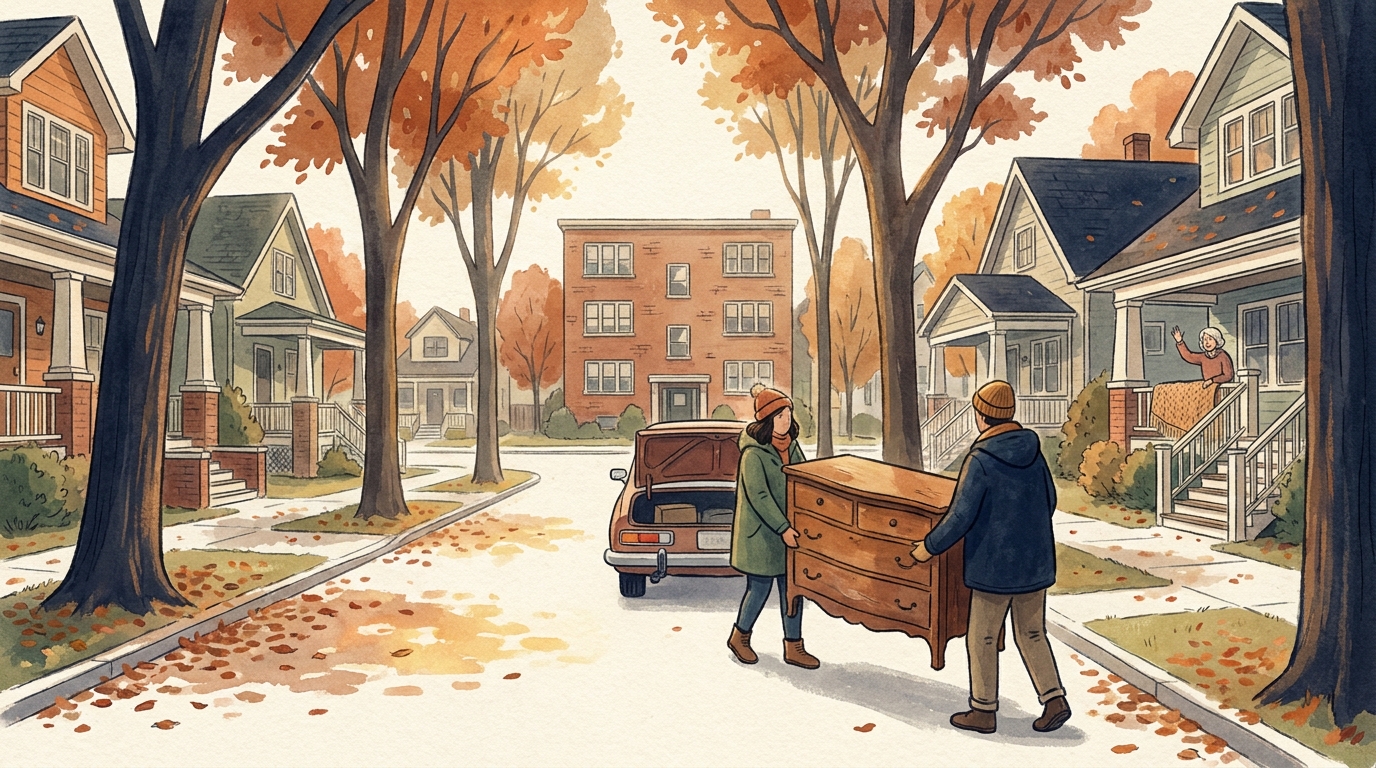
StuffRescue rescue story Akron — one neighbor, one dresser, one illustrative scenario.
This StuffRescue rescue story from Akron follows one dresser — unwanted at a garage sale — through the Giving Loop (POST → RESCUE → GRATITUDE → AGAIN) to a neighbor furnishing a first apartment, free. It's an illustrative, composite scenario, not a documented case: StuffRescue is still in its pre-launch Akron pilot, so this walk-through exists to show exactly how the mechanics work before a real, consented story is ready to publish.
StuffRescue is a free neighbor-to-neighbor giving platform piloting in Akron, Ohio. Editorial note: the people, neighborhoods, and conversations below are invented to teach the Giving Loop clearly. No real, named person is described. If you've ever stood over a piece of furniture nobody wants and wondered if there's a better option than the curb, this is for you — and so is the neighbor on the other end, furnishing a first apartment with almost nothing in it.
What is the Giving Loop, and how does one dresser move through all four steps?
The Giving Loop is StuffRescue's whole mechanism in four words: POST → RESCUE → GRATITUDE → AGAIN. A Giver posts something they no longer need, a Rescuer claims it free (within 3 miles) or for a flat 99 cents beyond that, charged only if the rescue succeeds, a short thank-you closes the loop, and — often — today's Rescuer becomes tomorrow's Giver. In this rescue story, a scuffed, slightly wobbly dresser is the thing moving through it.
- POST — a neighbor who no longer wants it puts it up, condition and all.
- RESCUE — a nearby neighbor who needs exactly that claims it.
- GRATITUDE — a short thank-you closes the loop between them.
- AGAIN — the Rescuer eventually gives something of their own.
How did the dresser almost end up at the curb instead of in this rescue story?
It almost didn't get rescued at all — it nearly went to the curb, because nobody at the garage sale wanted it. In this illustrative scenario, a six-drawer dresser with mismatched hardware and a sticky bottom drawer sat through an entire Saturday with a "$15" sign taped to it and no takers. By 4 p.m., the choices were: haul it to a donation drop that might reject it for the sticky drawer, set it at the curb and hope, or POST it to StuffRescue instead. The Giver chose the third option, photographed the sticky drawer and the mismatched pulls honestly — condition disclosure before a claim isn't optional on StuffRescue — and posted it that evening.
How does a neighbor RESCUE a free dresser nearby?
A neighbor finds it the same way anyone finds anything on StuffRescue: by looking at what's actually posted near them, free, with the flaws stated up front. In this scenario, a Rescuer furnishing a first apartment a few streets away had been searching for exactly this kind of unglamorous, functional furniture — something to hold clothes, not a showpiece. The dresser showed up in the local feed within the 3-mile radius, so it cost nothing to claim. The post was upfront about the sticky drawer and the mismatched hardware before any pickup was arranged, so there were no surprises at the door. Pickup happened that same evening.
What happens during GRATITUDE, and why does a quick thank-you matter?
GRATITUDE is the step most giving options skip entirely, and it's the one that makes the whole loop feel different from leaving a couch at the curb. In this rescue story, the Rescuer sent a short thank-you and a photo of the dresser already filling up with folded clothes in a mostly-empty bedroom — nothing elaborate, just proof that it landed somewhere specific instead of vanishing into an anonymous donation bin. Research on prosocial behavior backs up why that moment matters: people who spend on others, rather than on themselves, show a measurable happiness boost (Dunn, Aknin & Norton, Science, 2008), and economists have a name for the specific satisfaction a giver feels — "warm-glow" giving (Andreoni, The Economic Journal, 1990). A dollar at a donation box can't send that photo back. A neighbor can.
Why does GRATITUDE lead to AGAIN — and turn a Rescuer into a future Giver?
Because once someone has felt what it's like to be on the receiving end of a specific, generous thing — not a transaction, not an application, just a neighbor saying "yes, come get it" — they tend to look for a chance to do the same. In this scenario, the Rescuer who furnished a first apartment with a free dresser later had an old lamp they no longer needed. Instead of letting it sit in a closet, they posted it themselves — closing one loop by opening another. That's the Reactivate mission in miniature: stuff doesn't just move once. It keeps moving, neighbor to neighbor, as long as someone's willing to start the next loop.
What were the dresser's other options, and why does this one matter?
| Option | Cost | Speed | Catch |
|---|---|---|---|
| Curb, trash day | Free | Same day | Likely landfilled; no second life |
| Donation drop-off | Free (drop fee varies) | Depends on hours | May reject items with flaws like a sticky drawer |
| Facebook Marketplace | Free to list | Varies | Buyer/seller framing, no built-in thank-you |
| StuffRescue | Free within 3 miles; $0.99 beyond, on success | Same day possible | Pilot — Akron neighborhoods first |
Furniture is one of the hardest household materials to recycle at any real scale, with the large majority of what Americans discard ending up landfilled rather than recycled (U.S. EPA). StuffRescue doesn't publish a measured number of its own — the honest version stays qualitative: every rescue keeps something out of a landfill.
Where StuffRescue fits
This rescue story is fictional, but the mechanics in it are exactly how StuffRescue works. Giving is always free. Rescuing something within 3 miles is free too; reaching a little farther costs one flat 99 cents, charged only when the rescue actually succeeds — never to browse, never to claim. There's no application and no proof of need, for a dresser or for anything else. Facebook Marketplace turns neighbors into buyers and sellers; a Buy Nothing group (wonderful, and worth joining) has no built-in gratitude step or memory of the loop; StuffRescue adds both. Anyone who needs something specific but has nothing to trade for it can also post a Wish — it looks exactly like every other post, with no badge marking it as need. If you're in Akron, browse free furniture near you once the pilot opens, or join StuffRescue free now and help build the next rescue story in your own neighborhood.
Frequently asked questions
Is this a real StuffRescue rescue story from Akron?
No. This is an illustrative, composite scenario built to explain how the Giving Loop works, not a documented case — StuffRescue is still in its pre-launch Akron pilot, with real stories to follow once the platform is live.
What is the Giving Loop?
It's StuffRescue's four-step mechanism: POST, when a neighbor gives something away; RESCUE, when a nearby neighbor claims it; GRATITUDE, a short thank-you that closes the loop; and AGAIN, when that Rescuer eventually gives something of their own.
How much does it cost to rescue furniture like a dresser on StuffRescue?
Nothing within 3 miles of home — that's free, forever. Beyond 3 miles it's a flat 99 cents, charged only once the rescue succeeds, never to browse or claim.
What if the item has damage, like a sticky drawer or missing hardware?
Condition has to be disclosed honestly before anyone can claim an item, flaws included. A Rescuer sees exactly what they're getting before pickup is arranged.
How is StuffRescue different from a Buy Nothing group or Facebook Marketplace?
Facebook Marketplace treats neighbors as buyers and sellers. Buy Nothing groups are a great option and StuffRescue recommends them — they just don't have a built-in gratitude step or a memory of the loop. StuffRescue adds both, with free giving and rescuing inside 3 miles.
Sources
- Dunn, Aknin & Norton, "Spending Money on Others Promotes Happiness," Science (2008)
- Andreoni, "Impure Altruism and Donations to Public Goods: A Theory of Warm-Glow Giving," The Economic Journal (1990)
- U.S. EPA, Facts and Figures about Materials, Waste and Recycling — Durable Goods Product-Specific Data
Published by StuffRescue, a US nonprofit based in Akron, Ohio. Spotted something out of date? Email info@stuffrescue.co.
More from the blog
Garage Sale Leftovers: What Akron Neighbors Do With What Didn't Sell
Garage sale leftovers in Akron? See the real options — another sale, Goodwill, Habitat ReStore, Buy Nothing, or giving it to one neighbor who wants it.
Donating Furniture Without Sharing Your Address: How Pickup Codes Protect Survivors' Privacy
How pickup codes let you give furniture in Akron without sharing your address — a safety layer that matters most for domestic violence survivors.
What Teen Survivors Need That Younger Kids Don't: An Overlooked Gap in Shelter Donations
Teen survivors' shelter donation needs go beyond toys and small clothes. Learn what teens actually need and how to give it with dignity near Akron, Ohio.