
Published 6 min read
Donating Furniture Without Sharing Your Address: How Pickup Codes Protect Survivors' Privacy
How pickup codes let you give furniture in Akron without sharing your address — a safety layer that matters most for domestic violence survivors.
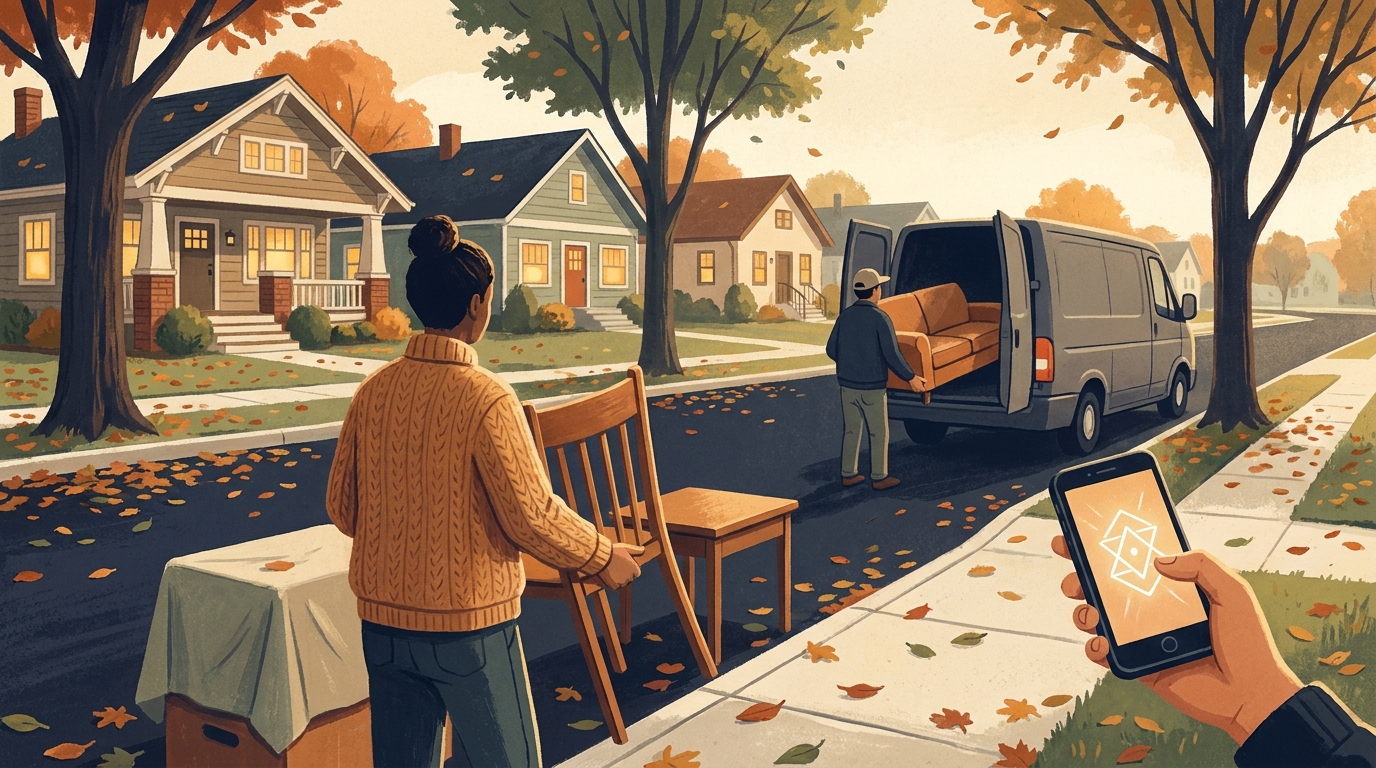
If you're searching for anonymous furniture donation pickup safety in Akron, here's the short answer: StuffRescue lets a giver and a rescuer complete a pickup using a one-time pickup code instead of a home address. Neither side has to say where they live. For most neighbors that's a nice convenience.
For a domestic violence survivor rebuilding a home an abuser doesn't know about, it can be the difference between giving a couch away safely and not giving it away at all.
This is for anyone giving away furniture in Akron who wants a safer way to do it, and for survivors, advocates, and Block Captains trying to understand why "don't share your address" means something different when safety, not just convenience, is on the line. Below: what general online-giving safety advice covers, where it falls short for survivors, and how pickup codes close that specific gap.
What do general safety tips for giving stuff away online actually recommend?
Most online-marketplace safety guidance centers on one idea: meet in a public, well-lit place instead of your home. The Fairfax County Police Department's guidance on online transactions advises arranging a meeting "in a safe, public location, such as a coffee shop, shopping center or police station parking lot," and notes that several police stations even designate safe exchange zones for exactly this. The logic: any online exchange — selling a bike, giving away a crib — hands a stranger information about where to find you if you do it at your doorstep.
That's solid advice for the general public, built around an unknown risk: a stranger you haven't met yet. It doesn't address the harder case, where someone already knows you, your name, and your routine, and is specifically trying to find out where you live now.
Why is address privacy a different, bigger issue for domestic violence survivors?
For a survivor, the risk isn't a random bad actor — it's someone with motive, patience, and often a history of monitoring. The National Network to End Domestic Violence's Safety Net Project, which focuses on the intersection of technology and abuse, has documented how ordinary location and address data can become a tool for locating a survivor who moved specifically to get away from someone. A public meetup spot solves "don't invite a stranger to my door." It does nothing to solve "don't let this specific person learn my new ZIP code, cross street, or building."
That's the gap general safety tips leave open: they guard against unknown risk, not targeted risk. A survivor giving away a crib she no longer needs, or a rescuer furnishing a first apartment after leaving, may need a system that never asks either side to share a location — not even a "safe" public one, which still means coordinating a time and place that can be watched.
How do StuffRescue's pickup codes actually work?
A pickup code is a short, one-time code generated for a specific handoff. The giver and the rescuer each see enough to complete the exchange — what the item is, roughly where it is in the Akron area, and the code itself — without either party exchanging a street address, apartment number, or phone number directly. No applications, no proof of need, no shame — just the code, scanned or confirmed at the moment of pickup.
This is a mechanical safeguard, not a promise that nothing can ever go wrong. It removes one specific, concrete exposure: having to type or say your home address to someone you don't otherwise know, or recognize. For a survivor, that's one fewer place her new location has to live in a text thread, an app profile, or someone else's memory.
What should a survivor still do beyond using pickup codes?
Pickup codes solve the address-sharing step of a handoff — nothing more. The Safety Net Project's broader guidance on technology and survivor safety is worth reading in full, because digital exposure runs wider than any single app: shared photos, location-tagged posts, even device settings can carry information a safety plan needs to account for. Treat a tool like pickup codes as removing one real risk, and lean on an advocate or a local domestic violence program for the rest.
| Safety practice | What it protects against | What it leaves exposed |
|---|---|---|
| Meet in a public place (general advice) | Giving a stranger your home address | Still requires setting a shared time/place a known abuser could watch |
| Use a "safe exchange zone" (police lots) | Physical safety during the exchange itself | Coordination often still happens by text/call that can reveal identity or timing |
| Pickup codes (StuffRescue) | Ever having to state or type your home address to the other party | Broader digital safety (device monitoring, social posts) — needs a full safety plan too |
Where StuffRescue fits
StuffRescue is a free-items giving platform piloting in Akron, Ohio — neighbors give, neighbors rescue, no address required between them. Everything within three miles is free to rescue, always; going farther costs a flat 99 cents, charged only when a rescue succeeds. Pickup codes aren't a survivor-only feature — every giver and rescuer uses them — but the effect matters most when hiding a home address isn't a preference, it's a safety need. Join StuffRescue free to try it, or see how pickup codes work before your first give.
If you run a shelter, a church, a senior program, or another organization that already supports people who could use this, we'd like to hear from you. We're building a Wish Program so organizations can bring the people they already serve into StuffRescue for their own giving drives — a request for beds for new arrivals, winter coats for a program's families, kitchen basics for someone starting over. If that's useful, reach out; we're still shaping how partnerships work and want to build it with the groups who'd use it.
Frequently asked questions
Does StuffRescue ever share my home address with the other person?
No. A pickup code is generated for the handoff so the giver and the rescuer can complete it without either person stating a street address directly to the other.
Is this feature specifically for domestic violence survivors?
No — every give and rescue on StuffRescue uses a pickup code. It's a general part of how the platform works, but the privacy it provides is especially important for anyone whose home location needs to stay unknown to a specific person.
What should a survivor do if they need more safety support than an app can provide?
Contact a local domestic violence advocate or program for a full safety plan; a pickup code removes one specific risk (sharing an address during a handoff) but isn't a substitute for professional safety planning. The National Network to End Domestic Violence's Safety Net Project is a good starting resource on technology and survivor safety.
Can an organization that serves survivors partner with StuffRescue?
Shelters, churches, and social-service organizations are welcome to reach out about the Wish Program, which is being built to let organizations bring the people they already serve into StuffRescue for giving drives. Partnership details are still being finalized.
Does giving away furniture through StuffRescue cost anything?
Giving is always free. Rescuing is free within three miles; beyond that it's a flat 99 cents, charged only when the rescue succeeds — no one in need ever pays.
Sources
Published by StuffRescue, a US nonprofit based in Akron, Ohio. Spotted something out of date? Email info@stuffrescue.co.
More from the blog
The Dresser Nobody Wanted Until One Neighbor Did: A Rescue Story
A StuffRescue rescue story from Akron: an illustrative dresser nobody wanted finds a neighbor furnishing a first apartment, free, through the Giving Loop.
Garage Sale Leftovers: What Akron Neighbors Do With What Didn't Sell
Garage sale leftovers in Akron? See the real options — another sale, Goodwill, Habitat ReStore, Buy Nothing, or giving it to one neighbor who wants it.
What Teen Survivors Need That Younger Kids Don't: An Overlooked Gap in Shelter Donations
Teen survivors' shelter donation needs go beyond toys and small clothes. Learn what teens actually need and how to give it with dignity near Akron, Ohio.