
Helping survivors & sheltersLast reviewed 7 min read
How Domestic Violence Advocacy Organizations Actually Source Household Goods for Survivors
How domestic violence shelters get donations in Ohio: the real mix of drives, wishlists, vouchers, and partnerships advocates use — and what's changing.
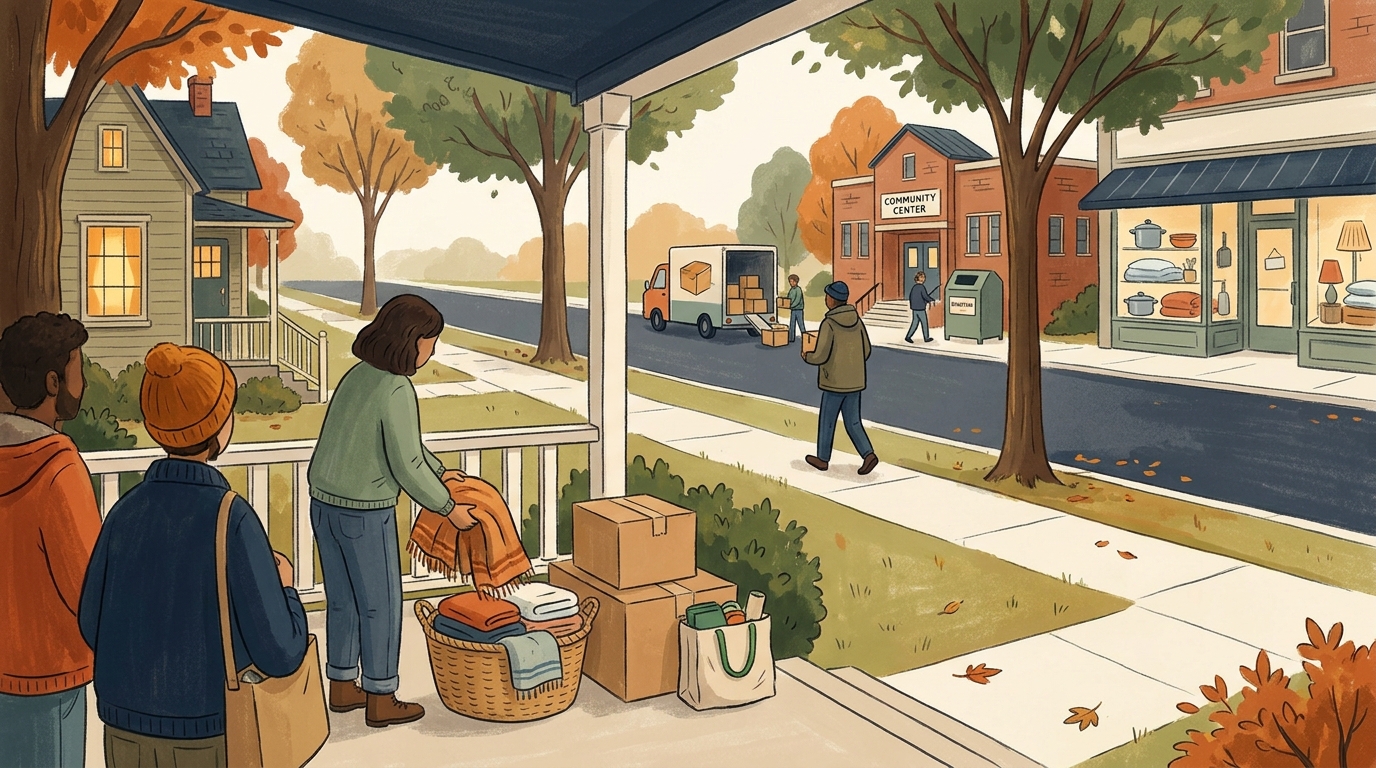
Most domestic violence advocacy organizations in Ohio piece together household goods from several channels at once: in-kind donation drives, an online wishlist — often Amazon — that ships to an office instead of a shelter, church and business partnerships, and occasional thrift-store vouchers.
When a gap opens, many lean on their statewide network, the Ohio Domestic Violence Network (ODVN), to help close it.
This is a behind-the-scenes look at how that actually works, written for advocates, church coordinators, and corporate volunteer leads — not for someone needing a hotline tonight. (For Akron's own example, see how to donate to Hope & Healing in Akron.) StuffRescue — the free, neighbor-to-neighbor giving platform piloting in Akron, Ohio — shows up at the end, as one more option, not a replacement for any of these.
How do domestic violence shelters get donations in Ohio, exactly?
There's no single pipeline. A typical Ohio domestic violence program stitches together several sources at once: a standing online wishlist for new items, periodic donation drives run by a church or workplace, individual donors giving cash or items directly, and referrals through the statewide coalition when a gap can't be filled locally. DomesticShelters.org, the largest searchable directory of domestic violence programs in the U.S. and Canada, reports that supporters have given more than $350,000 in donated items through its own giving platform alone — a sign of how much of this sourcing happens outside any single organization's four walls.
Because capacity and need shift week to week, the one constant is this: advocates ask donors to check the current list first, rather than show up with a trunk full of good intentions.
Why do most shelters use an online wishlist instead of posting an address?
An online wishlist lets a shelter accept exactly what it needs without publishing where it is. Shelter locations are confidential by design, a core safety measure, so a wishlist that ships to a P.O. box or administrative office solves two problems at once: it tells donors precisely what's needed, and it never requires anyone to know where survivors actually sleep.
Hope & Healing Survivor Resource Center, Akron's local advocacy organization, is a working example: due to limited capacity, it currently accepts in-kind item donations only through its Amazon Wishlist, and purchases ship directly to the organization, never to a public address. That's close to the standard pattern across Ohio Domestic Violence Network member programs, most of which keep some version of a wishlist for exactly this reason.
What do church and corporate partnerships actually look like?
Usually they're a standing relationship, not a one-time drive: a congregation that adopts a program's wishlist every quarter, a company that runs an annual donation challenge, or a local business that gives a percentage of sales. DomesticShelters.org's reporting on what shelters actually need points to Thread Talk, which donates a share of blanket sales to more than 2,600 shelters nationally, as one model built around a specific, needed item rather than a generic check.
The honest version: these take real coordination — someone on staff updates the wishlist, thanks the partner, and flags when needs change — labor that makes in-kind giving harder to scale than it looks.
How do thrift-store vouchers work for survivors?
Some programs arrange vouchers with local thrift or resale stores so a case manager can send someone in to pick out clothing, kitchenware, or furniture themselves, rather than handing over a pre-packed box. It preserves a measure of choice a fixed donation bin doesn't, and stretches a limited budget further than buying new. Habitat for Humanity ReStores — reuse stores that resell donated furniture, appliances, and household goods, with proceeds funding local home-building — are the kind of resale outlet this model runs through, though voucher arrangements are set up program-by-program, not published as a standard offer (see the note below).
What goes wrong with in-kind donation drives?
The two most common failure points are timing and sorting. A drive collects a surge of items at once — more clothing and toys than a program can store — while the one thing needed that week, like a crib or a working lamp, never shows up. Staff then sort and store what doesn't fit the list, invisible work layered on top of direct survivor services.
VAWnet's own donation guidance, from the National Resource Center on Domestic Violence's professional library, frames the fix simply: treat a household donation like a housewarming gift for someone starting over, organized by category — kitchen, cleaning, bathroom, paper goods, laundry, personal care — rather than a general clothing drop.
Where does Ohio's statewide network fit in?
When a local program's own channels can't fill a gap, the Ohio Domestic Violence Network is the next call. ODVN is a statewide coalition that brings training, technical assistance, and advocacy to more than 70 local domestic violence programs across Ohio, and its info line (1-800-934-9840) can point a donor, a partner organization, or a program itself toward the right local contact. The National Network to End Domestic Violence (NNEDV), the national umbrella for all 56 state and territorial coalitions, plays a similar role one level up — including publishing technology-safety guidance that shapes how local programs use tools like wishlists and donation platforms safely.
How do these sourcing methods compare?
| Method | Cost to the program | Speed | Best for | Catch |
|---|---|---|---|---|
| In-kind donation drive | Free to organize | Days to weeks | Bulk categories (clothing, hygiene, bedding) | Timing rarely matches need; sorting and storage fall on staff |
| Online wishlist (Amazon/Target) | Free to maintain | Ships in days | A specific, named item, shipped safely to an office | Someone has to keep the list current every week |
| Thrift-store voucher | Low; often subsidized | Same day for the survivor | Clothing, kitchenware, furniture chosen in person | Set up program-by-program; not every store or program offers it |
| Church or corporate partnership | Free; sometimes recurring funding | Ongoing | Steady, predictable restocking | Takes real relationship upkeep to sustain |
| Statewide coalition referral (ODVN) | Free | Varies | Filling a gap local channels can't | A referral, not a guaranteed source |
| StuffRescue Wish Program | Free to post; pay-what-you-want to give, $0.99 floor, charged only on success | Often same day in the Akron pilot | One specific item, routed through a verified partner | Pilot stage — Akron zones first |
Where StuffRescue fits
Every method above still depends on someone building a list, chasing a partner, or hoping a drive's timing lines up with need. StuffRescue's Wish Program sits alongside that work rather than replacing it: a verified local partner posts one specific, needed item — no name, no story, no address — and a nearby neighbor can give toward exactly that thing, often the same day in the Akron pilot. Every rescue keeps something out of a landfill instead of out at the curb, and because Wishes render with no badge of need, nothing about the post singles anyone out.
If you run a domestic violence advocacy organization, a church giving program, or any community organization that already connects people to help, we'd like to hear from you. StuffRescue is inviting nonprofits and community organizations to reach out about partnering through the Wish Program, so you can bring the people you already serve into it for their own giving drives — on your terms, alongside whatever you already run. No organization has signed on yet; this is an open invitation while the Akron pilot gets underway, not an announced partnership. If useful, join StuffRescue free and see how the Giving Loop works.
Frequently asked questions
How do domestic violence shelters get donations?
Most combine standing online wishlists, periodic in-kind donation drives, church and corporate partnerships, and occasional thrift-store vouchers, filling remaining gaps through their state coalition. Which mix a given program uses depends on its staffing and current capacity, so the list of what's needed changes week to week.
Why don't shelters just post their address for drop-offs?
Shelter locations are kept confidential as a core safety measure for the people living there. An online wishlist or a partner organization's office lets donors give exactly what's needed without anyone learning where survivors actually are.
Are donated items to a domestic violence shelter supposed to be new or used?
It depends on the item. VAWnet and most programs ask that anything that touches skin or hair — toiletries, underwear, bedding — be new, while kitchenware, furniture, and other household goods can be gently used as long as they're clean and complete.
What does the Ohio Domestic Violence Network actually do?
ODVN is the statewide coalition that supports more than 70 local domestic violence programs across Ohio with training, technical assistance, and advocacy. Its info line, 1-800-934-9840, can help point donors and partner organizations toward the right local program.
What is StuffRescue's Wish Program?
It's the part of StuffRescue that lets a verified local partner post one specific, needed item on behalf of someone they serve, with no identifying details, so a nearby neighbor can give toward exactly that need. It's open to nonprofits and community organizations that want to bring the people they already serve into it, alongside their existing giving drives.
Sources
- DomesticShelters.org
- DomesticShelters.org, "What Domestic Violence Shelters Actually Need"
- VAWnet (National Resource Center on Domestic Violence), "Donate Household Items"
- Ohio Domestic Violence Network
- National Network to End Domestic Violence
- Habitat for Humanity
- Hope & Healing Survivor Resource Center, Ways to Give
Published by StuffRescue, a US nonprofit based in Akron, Ohio. Spotted something out of date? Email info@stuffrescue.co.
More guides on helping survivors & shelters
Helping survivors & shelters
How to Start a Donation Drive for a Domestic Violence Shelter at Your Akron Workplace or Church
How to start a donation drive for a domestic violence shelter in Akron: what to ask first, what to collect, what to skip, and how to hand it off.
Moving & cleanouts
Moving Out of Akron? What to Do With Leftover Furniture
Stuck with furniture when moving out of Akron? See what movers won't haul, Akron bulk pickup rules, and the fastest free way to give it to a neighbor.
Moving & cleanouts
Spring vs. Fall Cleanout in Akron: Why Timing Changes Where Your Stuff Should Go
Spring cleanout competes with Akron's bulk pickup backlog and UA move-out. See the best time to declutter and donate in Akron, and what beats the wait.